To be fair, I don’t have the best track record with Bethesda’s huge role-playing games. Sure, I can say now that I’m happy to sink into life hours into Fallout 76 and (ZeniMax’s) The Elder Scrolls Online, that (Obsidian’s) Fallout: New Vegas is a true stand-out among stand-outs, and that I’ll take another round of Skyrim over most else. But it wasn’t always like that. It took me years to complete the main stories of both Fallout 4 and Skyrim. I cut Fallout 76 from my library for a time because it just such a mess. Thanks to Game Pass, I have repeatedly tried to get into both Oblivion and Morrowind, and I can’t seem to get off the ground with either.
Here I am now with Starfield facing the same scenario…only with more disenchantment.

When I first wrote about my experience with Starfield upon release, I summed things up as “enjoyable but imperfect.” As I continued my new adventures, slowly but surely, and to my dismay, the “enjoyable” portion of the game began to wear thin. Honestly, for a time, I couldn’t put my finger on exactly why. Starfield reads well on Bethesda letterhead. It has unique characters with different backstories. It has a variety of quests, many of which pop up from random encounters. It has lots of places to explore. Dialogue is plentiful, and some of the best conversations are stumbled upon rather than doled out directly. The game set in an interesting version of a future universe. It provides tons of crafting options, whether one wants to make weapons and armor or outposts and manufacturing facilities. It lets players choose how to approach any given situation, from guns blazing to quiet negotiation. It has all the comforts of a Bethesda game in a new package.

Why then does the game come off as so…what’s the right word…?
Boring.

During the time I’ve played, only one quest line has so far paid off in a satisfying way, and it involved one of my companions. One of the faction quest lines was moving along well enough, until I ended up in an unavoidable space battle, and the game’s space combat mechanics are…not fun. I was the middle of a different faction quest line that felt meaty, but I encountered some sort of bug that hampered progression. So, that’s stuck. The main quest has been only okay. That tracks with other main quests in other Bethesda games, but the one in Starfield has been particularly uninteresting. I did recently hit a point in it where things ramped up to the point of facing consequences, so that was good. Since I hear the game “opens up” with new game plus, if I can just get myself in a state of mind to barrel through the main quest, I think I might be okay.
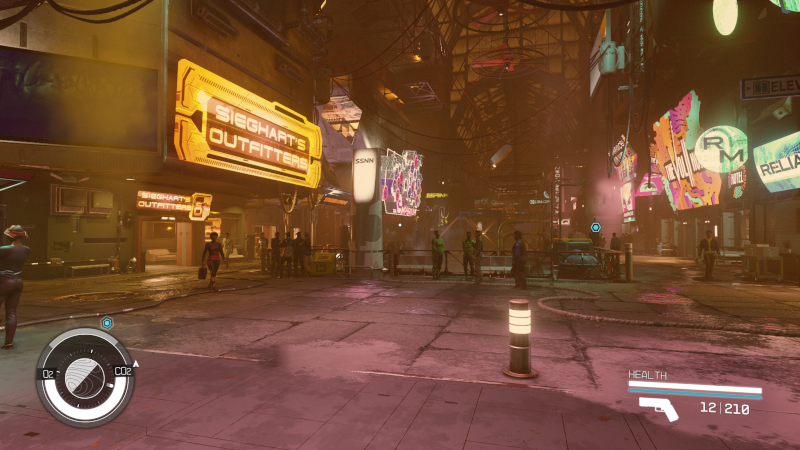
Problem is, there’s no compulsion to barrel through.
When I halted Starfield to play through Cyberpunk 2077, it was the best and worst mistake. My goodness, if they aren’t two modern end-of-the-spectrum takes on the RPG. On one side is Starfield with its talking heads; underdeveloped storytelling; vast, empty world; and mere sparks of engagement. It’s imbalanced, with difficult low-level enemies and easy high-level ones. (Though, you’ll never know which you’ll encounter.) It’s uneven, unrefined, and buggy. And, I honestly can’t tell what Bethesda’s ultimate aim was with Starfield. The game comes off as both old-fashioned, as if Bethesda wanted to try to recapture pre-Fallout 4 magic, and sandboxy to the point where the story is meaningless. If Bethesda just wanted to give players a galaxy in which to play, fine, but Starfield’s galaxy is a repetitive and dull playground at this point.

On the other side is Cyberpunk 2077. Its main story did not change with all the updates, but it was already quite engaging. The updates made progression feel more compelling, and made combat a joy to experience. Its characters move, express, and emote like human beings (in video games). Its story hooks players from almost the beginning, and slowly reels them in, handing out enough bait to keep them invested. Night City itself felt more alive than before, acting like its own organism within the game. It felt like surprises were embedded into every corner of its filthy, fabulous walls. Cyberpunk 2077 isn’t a perfect experience, but it’s fluid and nearly seamless in its presentation. It stands out as a brilliant example of what an RPG can be today.
Since completing Cyberpunk 2077, I’ve not been back to Starfield simply because I can’t get the extreme comparison out of my head. To my chagrin, I’ve not bounced off a Bethesda game as quickly as I have with Starfield. Again, I keep thinking that if I can find the will to get through its main story, there’s a chance I’ll find enough footing with the game to unlock its full potential. If that didn’t feel like such a chore at this point, because I think the same thing when I have to clean out the garage or mow the lawn (something good will come of my efforts!), maybe it’d happen sooner rather than later. The painful fact is that I’m not finding much fun in Starfield. Right now, anyway. I’m sure I’ll be back when the right, restless attitude settles in. And, perhaps, after Bethesda makes good on its promise to “support the game” for the better.
All images, including lede, were captured by author during Xbox Series S gameplay of Starfield (© Bethesda Game Studios).
 VIRTUAL BASTION
The way I see it, Starfield is a Bethesda game made by a version of Bethesda that kind of forgot how to make Bethesda games, as it only remembred the broad strokes and nothing else. They know what a Bethesda RPG is supposed to look like, but no longer remember the substance of what made those games fun. We saw the rumblings of this with Skyrim (in the streamlining of the RPG elements), saw it progress further with Fallout 4 with its emphasis on gunplay and a giant map (to the detriment of everything else), and we all know what went down with Fallout 76 by now. Starfield is just the latest iteration of this trend, unfortunately.
It’s kind of like what happened to BioWare games in recent years, though at least Bethesda Softworks wasn’t saddled with a ridiculously over-ambitious online multiplayer game…oh, wait….
LikeLiked by 1 person
Ha! The Bethesda-BioWare comparison is uncanny, really. Both gigantic studios, they’ve each experienced the classic “loose sight of what matters” problem. (Extra-extra-long development cycles, with staff coming and going over the course of years, don’t help matters any.) There really are shades of Mass Effect: Andromeda’s shallowness in Starfield, where with each, studios’ ambitions/demands replaced thoughtful game-making. Like you said, Bethesda remembered how to make Starfield a “Bethesda game” at only the surface level. The same was very true of Fallout 76 for a long time; it’s a much better game now…five years later. Is everyone cool with waiting several years until Starfield becomes a good game, if it even does? Guess we’ll see if its own “redemption arc” plays out eventually.
LikeLiked by 1 person
We’ve reached the point where there are two important dates for AAA releases: the release date (also known as the the start of paid beta), and the date when the game has actually become good/finished (or at least playable). I dunno about you, but I’m done paying to participate in betas.
LikeLiked by 1 person
Ain’t it the truth. As amazing a time as it is right now to be a video game player, never before have I felt *less* compelled to buy any game at release than I do now.
LikeLiked by 1 person
At least they’re helping us save money in that sense, right? 🙂
LikeLiked by 1 person
Now that’s putting a positive spin on things!
LikeLiked by 1 person