At the time of writing my Dragon Age: The Veilguard first impressions post, I claimed having a solid and mostly positive start. While it was plain to see BioWare’s work in weaving Veilguard into the Dragon Age series, it was difficult for me to detach from the events of Dragon Age: Inquisition – Trespasser. Because of that, I’ll admit that I harbored some ill will towards certain of Veilguard’s aspects, such as its force-fed directives, instances of subpar dialogue, and questionable character decisions. Playing the game felt fantastic, but playing within with boundaries of its interactions didn’t. Oh, I had no doubt then that I’d see the game to completion and then some, but I wasn’t sure that the game would “stick.”

It was around the game’s halfway point, during an intense battle involving the Grey Wardens, that things began to click. I became so engrossed in the present moment that I forgot all about my qualms. With blossoming friendships by Rook’s side and formidable foes to best, I began to let go of the Dragon Age game that I thought I wanted and started playing the Dragon Age game I had. I got lost in its twists and turns, listened intently to my companion’s hopes and fears, traveled across new lands in search of new treasures, and summarily picked up my jaw from the floor in the game’s final throes, and at one revelation in particular. Never have I been so glad to be caught off-guard.
Aside: While I enjoy replaying personally memorable games, rarely do I start such a game over immediately. I prefer to let any given unique experience percolate for a little while. With Veilguard, however, I began a new Rook immediately upon the credits roll. As much as I enjoyed with game as a two-handed warrior, I was absolutely dying to try it out as a mage. That playthrough is ongoing and will likely be much slower and more comprehensive than the first.

**SPOILERS ahead!**
Dragon Age: The Veilguard tells the story of Rook, a member of a small team led by the irascible but loveable storyteller Varric Tethras of Kirkwall. He not only befriended the champion who saved his hometown from a battle between Templars and mages, but he worked closely with the inquisitor to bring peace Thedas’s southern lands. Along with the inquisitor, Varric befriended Solas, a broody elven mage who appeared to be on the side of good. In reality, however, Solas was the corporeal form of Fen’Harel, also called the Dread Wolf, an ancient elven trickster god. In a bid for power long ago, Fen’Harel imprisoned the remaining seven elven gods – the Evanuris – in a self-made boundary between the world of the living and that of the dead (the Fade) called the Veil. While the Veil kept the elven gods at bay, allowing Fen’Harel full reign, unfortunately for the ancient elves, the Veil kept them from accessing the Fade, the source of their power and magic. Over time, the elves lost their connection to the Fade, and their history, completely.

With centuries of regret in tow, Solas vowed to remove the Veil and restore the elves…which wouldn’t be so bad if it didn’t also mean the end of the world. For the Veil also kept the demons and monsters of the Fade away from humanity. Its destruction would bring about nothing but death and destruction for everyone else. Knowing this, Varric began hunting Solas, eventually tracking him to Minrathous, capital of Tevinter, a land run by human mages. There Varric recruited friend and Inquisition scout, Lace Harding; a keen, local detective named Neve Gallus, and muscle-for-hire he nicknamed Rook. Together they find Solas in the midst of a grand and spectacular ritual to end the Veil. Stopping Solas in his tracks is no easy task, but they manage to do just that, and it’s not without consequences. Not only is the team badly injured, but the process ends up releasing two angry elven gods bent on revenge and traps Solas in the Fade.
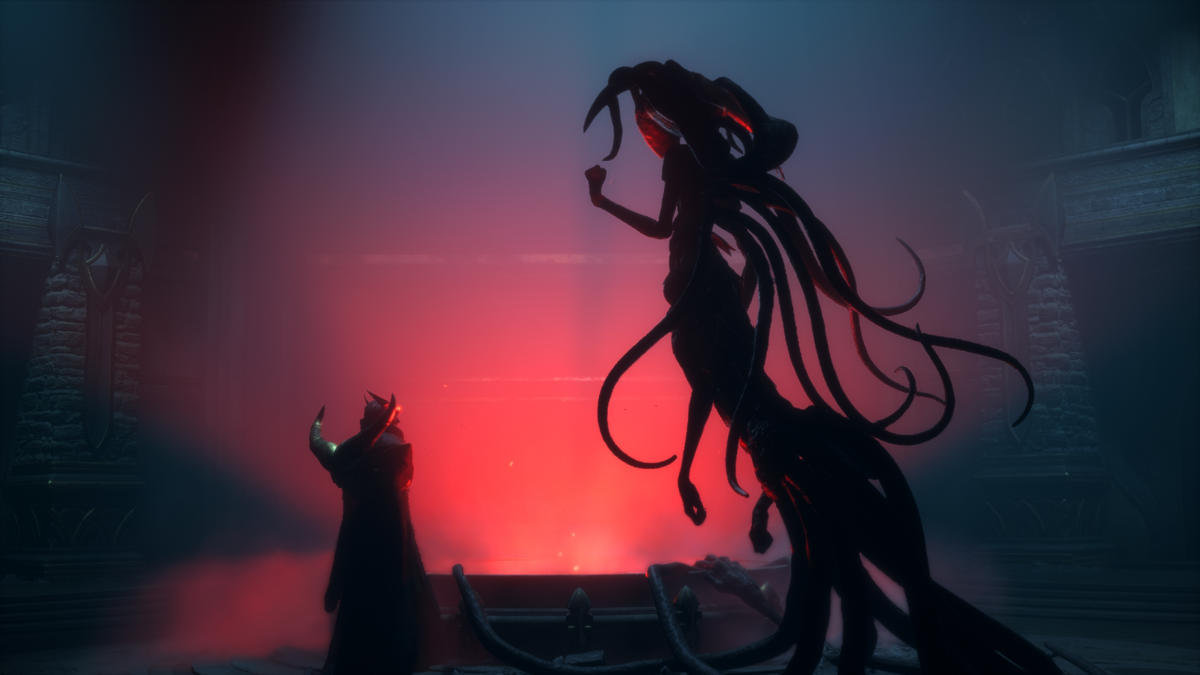
From there, Veilguard’s story takes off in a bounded but boundless way, thanks to the existence of ancient, magical mirrors called “eluvians” that serve as an ethereal transportation system across Thedas. One eluvian leads to Solas’s old home in the Fade called the Lighthouse, which Rook and crew utilize as a home base. From there, they gain access other eluvians in the Crossroads, a land of spirits within the Fade itself.
Or…once players start finding locations and their various beacons, they can fast travel between them and bypass the Crossroads entirely. This is a game, after all.
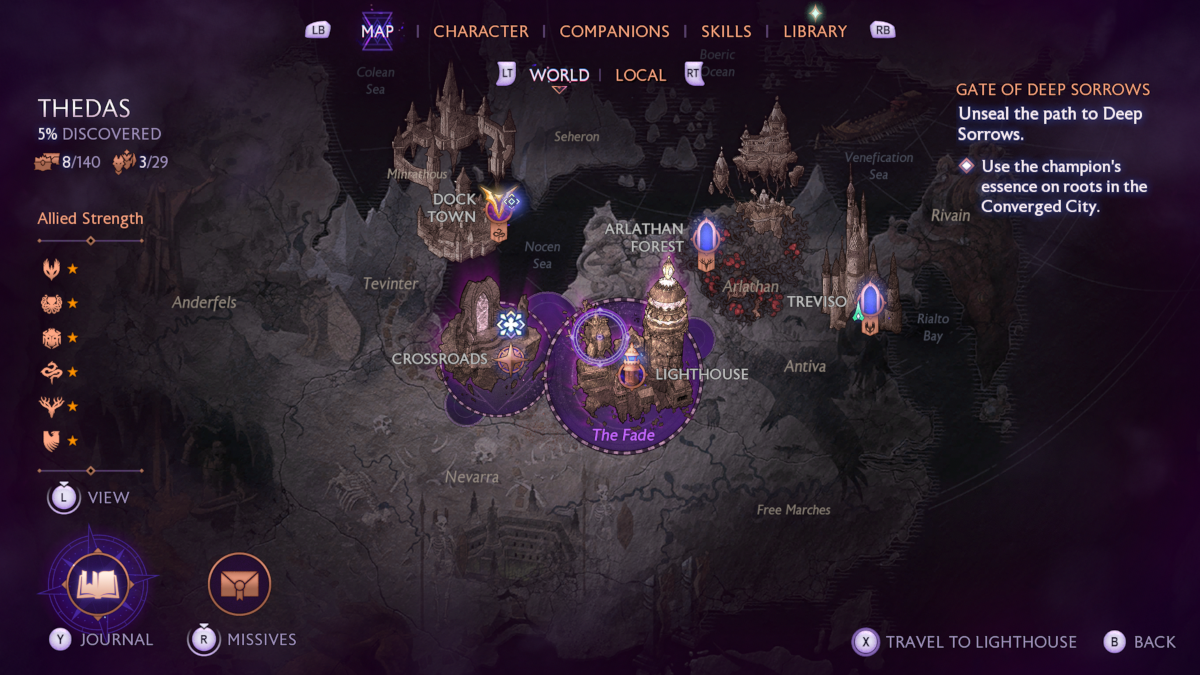
To the “bounded but boundless” point, Veilguard is not open-world a la Inquisition. Rather, it’s a welcome return to Dragon Age: Origins’ setup with location-based quests and sidequests. And what locations there are to explore! Each region, city, or even individual structures, feel vast and are brimming with secrets to uncover. Exploring everything in Veilguard to the fullest is a process in and of itself, and I didn’t come close to opening up any given section to 100% during my first playthrough, save for the Lighthouse itself. It does make me wish that there was a new game plus mode, or something like Inquisition’s “golden nug” (to link collectibles through different playthroughs), because though I happily started the game over immediately, re-exploring is a little intimidating. (Eh, we’ll see how far I get with my new mage, anyway.)
And what of all the stuff that’s worth gathering in Veilguard? Well, for one, yes, there’s loads of garbage loot to either pick up or ignore. The best loot, however, can be found in chests that are very helpfully marked on the map. What’s really great is that the loot system is tied to gear upgrades rather than gear itself. Once a piece of gear is obtained, upgrades to it can be (admittedly randomly) found. That said, if you don’t want to simply hope to find upgrades, the game also offers a crafting system to both upgrade and enhance gear. This goes for not only Rook’s gear but companion gear, too. The crafting system itself requires upgrades, so, there is that small hurdle to consider. Inquisition had a somewhat similar system that I rarely used; in Veilguard, I mostly used crafting to upgrade companion gear, but it wasn’t a necessity.

Speaking of necessity, Veilguard makes plain that Rook’s companions and solving their troubles are of the utmost importance…despite the rampaging elven gods, but who’s counting? Indeed, in order to make the Veilguard as ready as they can be for the final battle, Rook must attend to their individual quests. While this notion is unfortunately beaten over players’ heads, the game’s companions quests are among the best such quests I’ve ever played, and that includes the stellar ones in Mass Effect 2. From aiding in the elves salvation to learning of the intricacies of dwarven culture to rejoining Gray Wardens with their past, each quest was substantial and fantastic. By the time there were all said and done, it truly felt like I had a team of trusted friends by my side at the final battle. It was almost enough to make me forget all about my Inquisition hang-ups and see Veilguard for the game that it is.
Almost.
Dragon Age: The Veilguard is a very good but very strange game. I don’t know quite how to describe what I mean by “strange,” but it’s almost like BioWare took the beginning, middle, and end, from whatever might have been “Dragon Age: Dread Wolf,” and inserted “Veilguard” moments in between them. I loved building Rook from a nobody into a somebody. I loved working with a set of unique and compelling companions, helping their various circles, and fostering their efforts to become the best versions of themselves. I loved exploring a large expanse of northern Thedas that was brimming with beauty and character. I loved Rook, too. I love his dialogue, I loved the voice acting, I loved that he was more than just a blank slate spouting conversation choice verbatim. What I didn’t love was that neither the “Dread Wolf” nor the “Veilguard” played significantly into Rook’s overall story. His path essentially diverged onto two separate roads that never met. On one path, Rook and his team are very serious about saving the world from a mistake; on the other, Rook’s petting griffons, taking part in murder mysteries, and playing rock-paper-scissors with a skeletal buddy. Dragon Age: The Veilguard is like playing two games at once, that’s what’s unsettling.

All this really is in keeping with my Dragon Age first-playthrough problems – I didn’t really get off on the right foot with any of them, and I changed my tune with subsequent playthroughs. That said, Veilguard does suffer from having a “patched together” feeling, which probably explains why some its over-world writing heavily misses the mark. Veilguard is at its best in close quarters, when Rook’s getting to know his team, and even when the teammates get to know each other and the others around them. These moments are truly brilliant, and if they only tied in more securely to the game’s main story, maybe Veilguard would be wholly brilliant, too. As it stands, Dragon Age: The Veilguard is good game that feels great when the “big bads” aren’t reminding you that there’s a world to save. I’d much rather spend time sightseeing around Tevinter with my friends, but alas, no rest for the weary.

Lede images and videos were captured by author during Xbox Series S gameplay of Dragon Age: The Veilguard (© BioWare).
 VIRTUAL BASTION
One Comment
Comments are closed.