The Trine games are a series of fantasy 2D platformers with physics-based puzzles and 3 playable characters. I’ve been writing a lot about the series lately, so this is feeling rather redundant at this point. But to recap, you’ve got Amadeus the wizard who can conjure various shapes and levitate objects, Zoya the thief, who is agile and possesses the ability to grapple to wooden objects and shoot arrows, and Pontius the knight, the most basic character, who can fight and defend with his sword and shield. At long last, after having already played Trine 2-4, I finally got around to playing the original Trine (well, more precisely, the so-called Enchanted Edition). Expecting it to be rather basic compared to later entries in the series, I was quite pleased to find that its simple nature proved to be part of its appeal, even if it may have been lacking in a few areas.
Starting at the surface, the Trine games are generally very beautiful and detailed, though I wouldn’t say the first game is quite as lovely to behold as the second and fourth. The game is also fairly short, at roughly 5-6 hours, though it can take a bit longer to get 100%. Though I actually preferred the shorter levels (of which there are 15) because they don’t drag as much as the longer levels of the later games. There is also a bonus level in the Enchanted Edition called Path to a New Dawn, but it wasn’t really worth it. The story is also pretty basic and forgettable, with something to do with the undead coming back to life (it sounds more exciting than it really is), and the ending didn’t feel satisfying at all. And while this is our first time meeting our trio of heroes, I didn’t feel like their personalities were very developed compared to later entries (though Amadeus flirting with Zoya at the start was…interesting).

Fortunately, despite the above nitpicks, I really enjoyed the gameplay, which gets to the point without dragging out the levels beyond what is necessary or giving us an excessive amount of collectibles to acquire. Our heroes start with their basic abilities, and they gain a few as the game progresses. There aren’t a bunch of optional abilities like in other games, but you can upgrade the few that you have using the experience gained from collectibles or from defeating enemies (pretty much all skeletons). Honestly, some of the abilities aren’t really worth mentioning, but the noteworthy ones include a floating triangle that Amadeus can conjure (which was not available in the other 3 games I played) and Zoya’s fire arrows, which can be upgraded to explode. These were actually available in the second game, but they’re too awesome not to mention!
One thing that changes in pretty much every entry is how the game handles it when your character dies. In this game, characters do not respawn unless you reach a checkpoint, and even then, they don’t recover their full health. Which somewhat alleviates the second game’s issue of rendering you practically immortal. This, along with the addition of mana, didn’t really stop the game from being rather easy, though. Conjuring shapes with Amadeus uses mana, but it was never a hindrance. I ran out of mana once and only once with Zoya because I shot too many fire arrows at a mini boss. And I assume Pontius uses magic when doing his special attack, but I almost never utilized it. Oh, and in this game, treasure chests give you items that can be assigned to your characters for various benefits, such as more mana or less damage taken or the ability to conjure more boxes. This is a nice change from the pointless paintings and poems found in the second game’s treasure chests, but also rather unnecessary considering how easy the game already was to begin with.
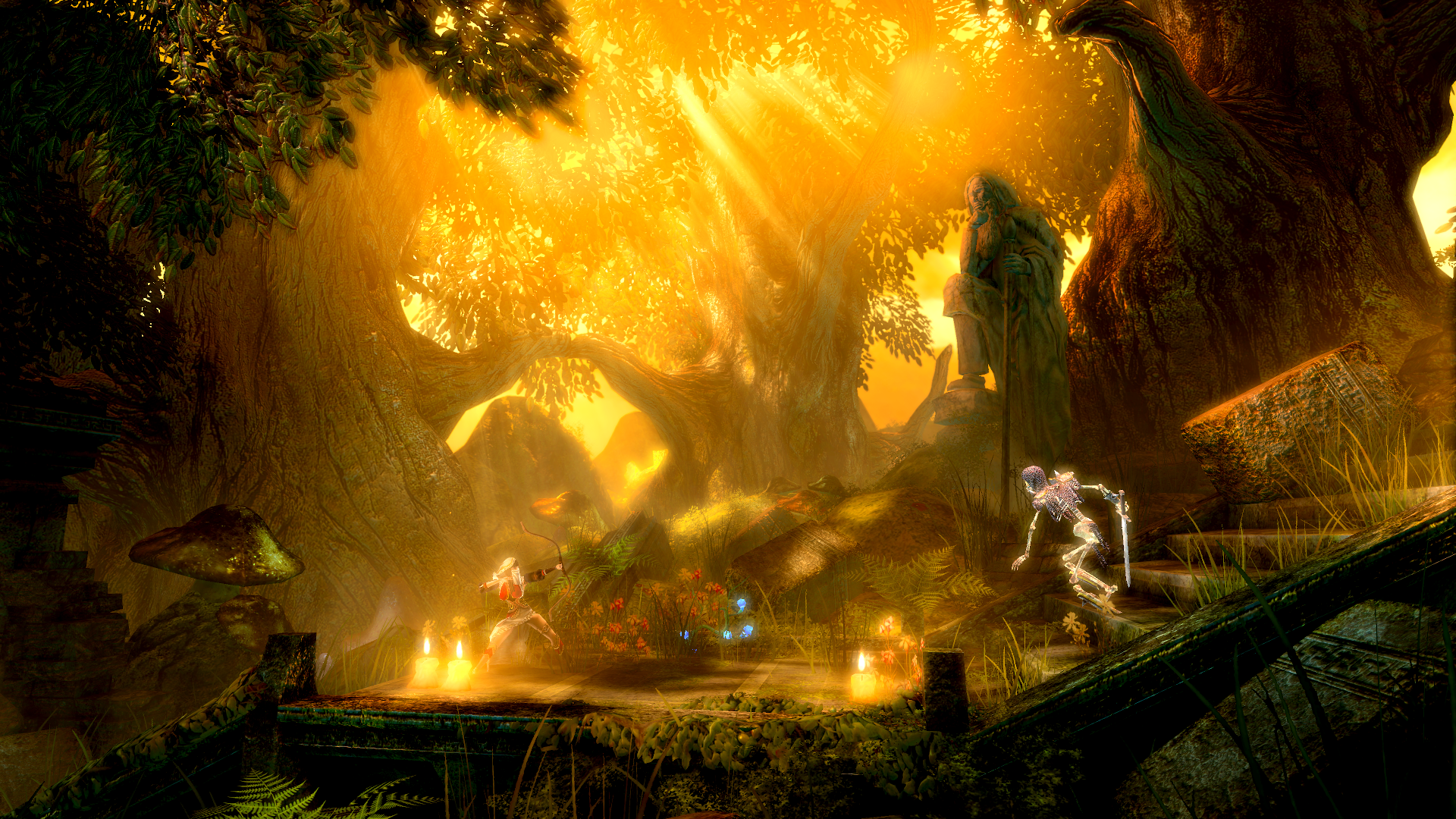
In summary, the first Trine is basic, but fun and satisfying to play without adding a bunch of frustrating mechanics or weirdly placed collectibles. And yet, it also simultaneously includes a bunch of elements that add pretty much nothing. If you’re looking for a unique puzzle platformer, then the original Trine is not a bad option, especially if you’re short on time. I actually really enjoyed and appreciated the game for its simplicity. Plus, unlike the second game, many puzzles can’t simply be bypassed by stacking a pile of boxes and gliding across. As I’ve said before, the puzzles are physics-based, so you’ll be stacking boxes, weighing things down, swinging from things with Zoya’s grappling hook (Zoya is easily the most fun character to control), and so on. Oh, and you’ll be fighting some enemies along the way, too, but this luckily doesn’t distract too much from the puzzling. The battles are pretty easy, plus it can also be quite amusing to push skeletons into spikes or water or simply watch them run headlong into danger without paying attention to where they’re going.
With that said, if you want a longer game with more creative puzzles, I’d recommend Trine 4: The Nightmare Prince, my current favorite of the series (I haven’t played the fifth game yet). And Trine 2 is good, too, despite the aforementioned ease at which you can glide over most obstacles…and the frustrating placement of many of the collectibles. Just avoid Trine 3 unless you get it on a good sale, as the 3D environments aren’t as good as the 2D ones, and the game is unfinished and ends abruptly.
Trine: Enchanted Edition is available for $14.99, but can also go on sale for $2.99. Though, if you’re interested in the series in general, might I recommend getting the Trine: Ultimate Collection on sale for a very fair $12.49 (normally $49.99), as it contains the first four games and is available on all major consoles and PC.
All screenshots downloaded from official Trine press kit
 VIRTUAL BASTION