SPOILERS from the get-go, while my complaints about The Talos Principle 2 are mostly minimal, when I discovered late in the game that I could not return to New Jerusalem, essentially the game’s “home base,” before reaching the endgame, I felt decidedly sour. If something or someone had indicated a point of no return earlier, I completely missed it. This is not really a knock against the game but just a warning for potential players. Make the most of the time you have in New Jerusalem, because at a certain point, you won’t be able to go back!
Now, with that out of the way, let’s talk about The Talos Principle 2. If I had played it when it released last year, I would have a knockdown, drag-out fight with myself in choosing my 2023 game of the year. It is an amazing and immersive game, one that’s as thought-provoking as it is mind-bending. Not only does it improve upon The Talos Principle as far as puzzles go, but it also adds an unforgettable story with a philosophical bent that makes players consider what it means to be a civilization.
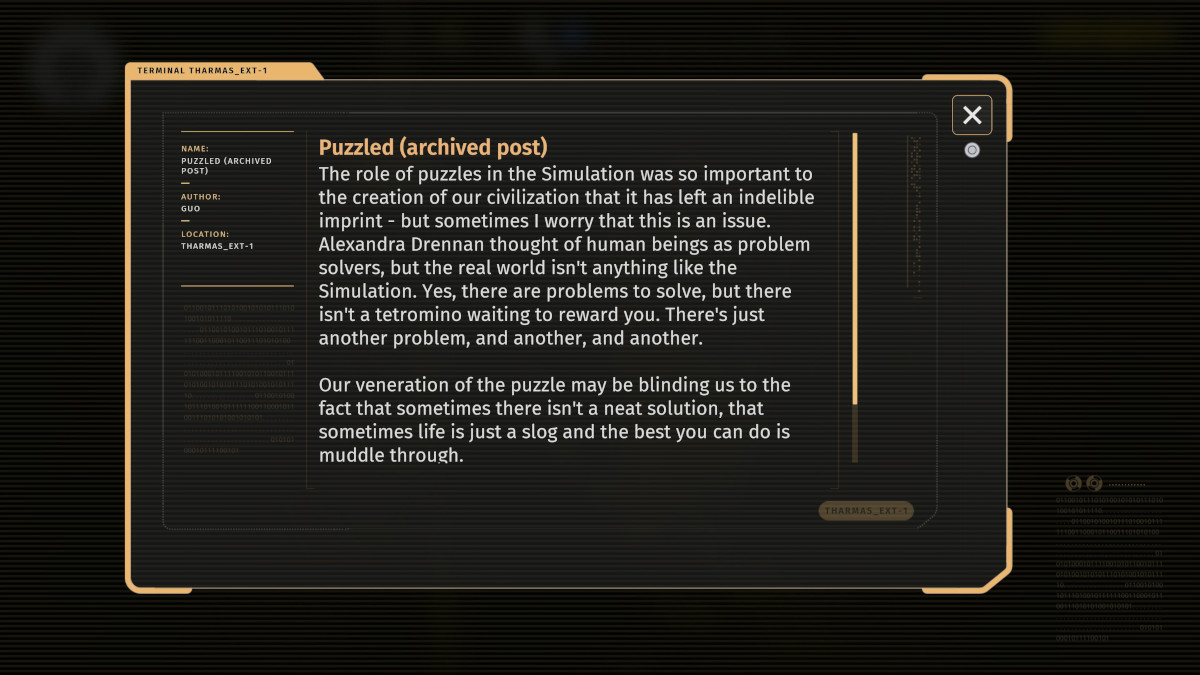
Unlike in the first game, The Talos Principle 2 does not take place in a simulation. It occurs in a city called New Jerusalem and its surrounding region. New Jerusalem is inhabited by a civilization of androids with roots in humanity, which was wiped out centuries ago by a pandemic, and desires to thrive. With resources galore, they are only limited by themselves, figuratively and literally, in that they can number only one thousand individuals. Players take the helm of the aptly named “1K,” the final android to be produced. With no ties to New Jerusalem’s population or politics, 1K holds the unique position of being the ultimate independent citizen, one who, as it turns out, has a particular penchant for puzzle-solving. When a massive energy surge outside the city and a visit from an energy force calling itself “Prometheus” happens in New Jerusalem, curiosities begin sparking. To figure out what’s going on, 1K is asked to join an expedition to the city’s outskirts, which results not only in the discovery of a giant pyramid called the Megastructure, but also the existence of puzzles strewn throughout twelve different areas around the massive monolith. Solving these puzzles, the team finds out, holds the key to the secrets of the Megastructure, as well as their own past, present, and future.
On paper, the premise of The Talos Principle 2 sounds a little heavy-handed, but its story actually plays out quite gracefully. Elements of philosophy and mythology help keep things both interesting and grounded without players feeling like they are being hit over the heads with questions of morality and mortality. (Though, these questions certainly do come up.) The game leaves it up to players to figure out just how much they care about what’s going on. Those who just want to solve puzzles will have as grand as time as those who want to understand what makes New Jerusalem and its inhabitants tick. Like in The Talos Principle, some story bits in the sequel come from the long gone past, a poignant time when humans were on their last legs. But for the most part, The Talos Principle 2’s story revolves around the androids, from the very first ones who established the civilization from humanity’s remnants to the lives of 1K’s present-day companions. What’s most moving is learning how these androids, effectively immortal beings, grapple with life, death, and everything in between.
Thankfully, the game’s puzzles offered plenty of respite from the “big questions.” As I mentioned in my first impressions post, The Talos Principle 2 begins in the world of the first game. But, it’s a short return, and before too long, players are let loose in a world ruled by some fairly ingenious mechanical- and physics-based puzzles. They are clever and satisfying, outside of a few that were more random-trial-and-error rather than intuitive (based on learning by doing), often offering multiple paths to solutions. To progress, eight puzzles must be solved within each of twelve different areas. While the puzzles are numbered and players are directed to them in order, they can pick and choose what they want to solve. As well, each area offers exploration and further secrets to uncover, like hidden labs that reveal puzzle mechanics, text and audio files from the past and present, and unique puzzles to master.
If the story and puzzles of The Talos Principle 2 aren’t engrossing enough, it is impossible to not become entranced by the environments. No horrors live outside of New Jerusalem…save for the ones that live inside our minds…each land, whether grassy or rocky or snowy or sandy, is nothing but serene. The individual areas are also somehow imbued with emotion, with some feeling happy or joyful, lighthearted and airy, and others feeling sad or anxious, darker and dourer. These regions also conjure up senses of solitude, loneliness, abandonment, pride, anguish, and futility. The world of The Talos Principle 2 is a character in and of itself, and it’s hard to not become attached to both its overwhelming sense of familiarity and its veritable oddness.
For anyone who enjoys puzzles and good stories in games, I cannot recommend The Talos Principle 2 enough. It might just be the finest puzzle game I’ve played since the first one, or perhaps Portal 2. As I said at the start, my only gripe with it is that the point of no return wasn’t stressed strongly enough. Once the endgame is in sight, the only thing players can do is play through it to get its multiple endings; there’s no going back to New Jerusalem. Other than that, The Talos Principle 2 is, to paraphrase a particular umbrella-wielding nanny, practically perfect in every way.
Lede image and video were captured by author during PS5 gameplay of The Talos Principle 2 (© Croteam, Devolver Digital.)
 VIRTUAL BASTION