Described by the developer as a “cozy management game about dying”, Spritfarer follows the story of Stella, who has been tasked with ferrying the spirits of the dead to the afterlife. Joined by her trusty cat Daffodil, Stella will be sailing about the ocean, looking for spirits and caring for them until they’re ready to move on. After having played the demo and already growing rather attached to the three spirits in my care, I couldn’t help but purchase this game the moment I saw it go on sale. What followed was a challenging (and not because of the game’s difficulty) journey that was ultimately well worth the struggle.
Spirits in this game are portrayed as anthropomorphic animals (I believe they’re supposed to be the “spirit animals”, if you will, of humans who are on the verge of death). The characters are well-designed and animated beautifully, the dialogue is witty (although there is A LOT of it), and the music is generally pretty pleasant, except for the times it’s ominous when it ought to be. Your main goal will be to keep your spirits happy and comfortable until they’re ready to move on, and this is accomplished in several ways.
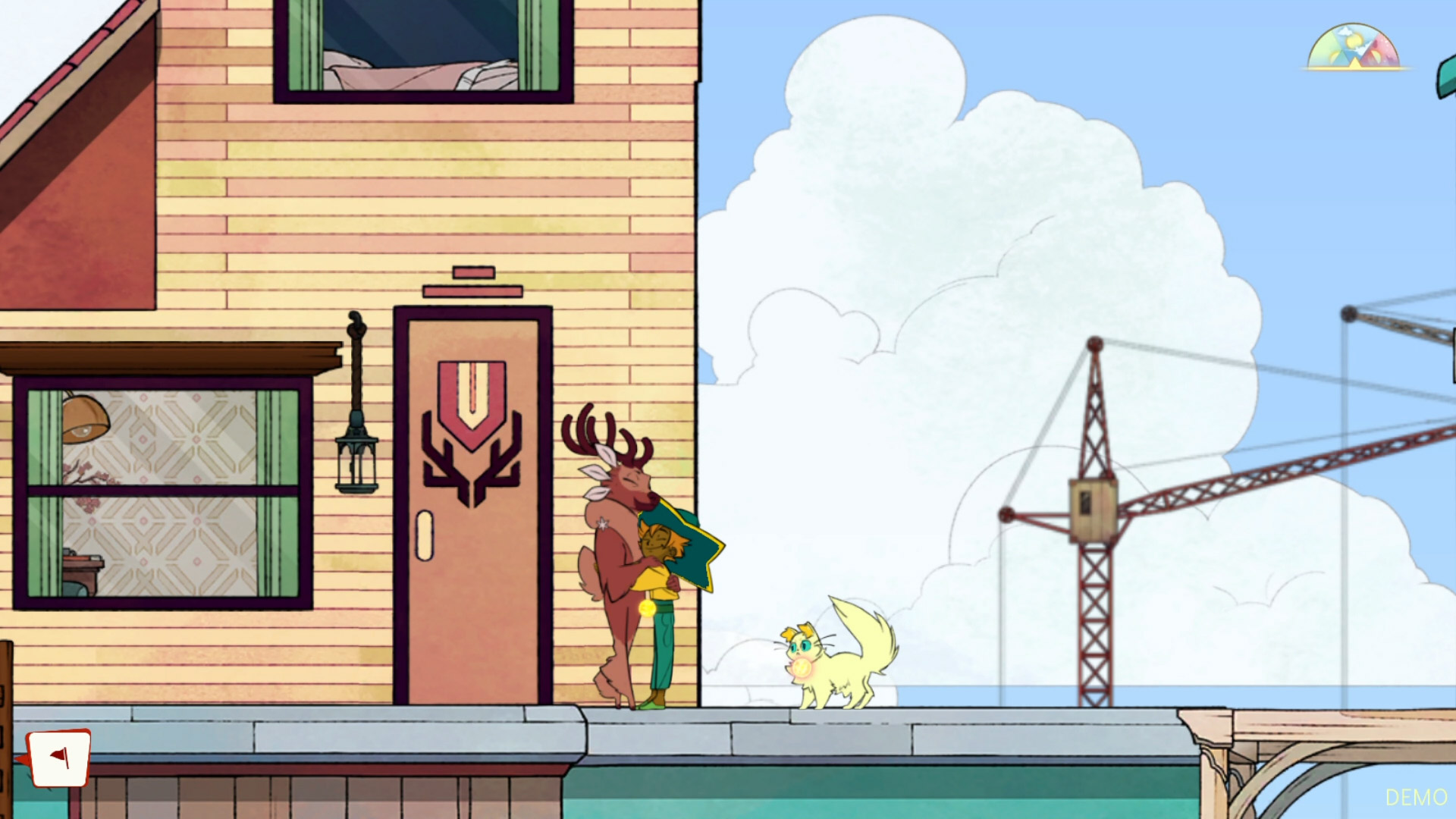
First off, every character has five options when you interact with them. You can give them items (although this isn’t used very often), you can feed them (feeding them their favorite food can really elevate their mood), talk to them, hug them, and check on their mood. The higher the mood, the more perks they will offer, such as giving you items or playing a happy tune that cheers up those around them (or in Summer’s case, helps the plants to grow).
Being a management game, you will find yourself quite busy as your ship travels between the various islands. You’ll have thread and fiber to weave in the loom, logs to saw into planks in the sawmill, and a garden and field to tend to, among other things. You will need these materials and more in order to build more facilities on your ever-expanding boat, including homes for your spirits, and upgrades for your boat in order to travel to new sections of the map, such as an icebreaker to break through walls of ice. You can also place the buildings wherever you want (within a set area, of course), meaning there’s some customization to your boat’s layout, which I really enjoyed. I ended up with a garden and farm on the bottom left level of the boat, with a little neighborhood above that. On the right side, I placed my least favorite spirits, which had to live in the “industrial” side of the boat where all the noisy equipment went. (They should have thought twice about their bad behavior.)

As you explore various islands, you can find new spirits, complete side quests (the less important ones are labelled “Shenanigans”), and gather materials, such as cutting down trees for logs and mining for mineral deposits. There are also plenty of other mini game-esque tasks you will need to complete, as well. For starters, there are many places on the map where you can gather supplies, as long as you’ve obtained the associated spirit on your boat. One character will have you gathering jellyfish as they fly by for bright jelly, another will have you getting struck by lightning in order to collect literal lightning in a bottle, and yet another will have you collecting ore off the back of an infected dragon. Processing materials on your boat is also a mini game of sorts. For example, you must hold a button until it hits just the right spot to get more from your loom, and you’ll get more planks if you can cut along the yellow line as the logs pass through your sawmill.
Probably the weakest aspect of Spiritfarer, however, is the gameplay. That doesn’t mean the game is not fun to play, but some tasks are certainly less enjoyable than others. Mining is one of my least favorite activities out on the islands, as I felt you had to hit the rocks too many times in order to break it, while the smithy is the most tedious activity to perform on the boat. Fortunately, you may not need to be quite as diligent as I was, as I ended up with an excessive amount of materials by the end of the game.
The game is also rather glitchy. Sometimes the game would stutter or even freeze for a split second as I moved about on my boat, and during one play session, Daffodil’s animations were completely broken. Sometimes, the cat would be frozen in a side view position, but even more frequently, the cat would either be stuck staring right at me or away (meaning I spent a lot of time staring at its fluffy butt). Daffodil would swap between these two positions whenever I passed through a door. The worst glitch, however, was when Stella was unable to interact with her bed and go to sleep. You can’t travel at night, so I had to just wait for night to pass before I was able to start moving again. I think what triggered this glitch was visiting the meteor shower before I had the necessary character to start the associated event. So my advice would be to steer clear of these sections of the map until you’re prepared. A few other complaints are summarized below:
- A decent number of optional side quests resulted in no reward.
- NPC’s all look very similar, and it’s very difficult to tell which ones are important and which one aren’t, leading to me frequently having to speak to everyone on an island just to locate the one person I was looking for.
- Why can’t I see into buildings on the various islands? You can see inside buildings on your boat, but for buildings elsewhere, you have to guide Stella based on what you can see of her through the windows.
- Once you get some sheep on your boat, there doesn’t seem to be any way to get rid of them if you decide you no longer want them or you have too many.
And last of all, this game doesn’t always flow as well as it should. For the first half of the game (barring the very beginning), I was frequently stuck, with no idea how to proceed or gather the materials I needed. For example, you would need the Zipline ability to enter a mine and get marble, but you need marble before you can get the Zipline ability, leading to me having to scour shipwrecks in the hopes that they’d drop the material I needed (and they often didn’t). Honestly, I don’t think I’ve ever played a game before where I had to rely on a guide this much, and I’ve read that other people had the same issue.
Fortunately, the sometimes frustrating gameplay and glitches don’t stop Spiritfarer from being an amazing experience, and I luckily had a much better time with the second half of the game, during which I had access to most of the materials I needed to progress. But let’s move on from the gameplay now, shall we, for it’s the characters and the subject matter that elevate this game into the poignant masterpiece that it is.
Although you’d think this would be a rather sad game (and it is), Spiritfarer is not depressing, but rather bittersweet and poignant, a wonderful game that handles death in a manner that doesn’t forget to celebrate the life of the person that you’re letting go. Not all spirits are as memorable or as likable as others, but in general, I enjoyed getting to know these different personalities, learning about who they were. and listening to their thoughts on the life they lived and the end that’s soon to come. Even when I was dealing with spirits who were less than pleasant (with the exception of a certain pair that I simply couldn’t stand), I found myself caring about them, even if I didn’t particularly like them. Now that’s an amazing thing, isn’t it, crying for and missing someone who wasn’t always kind to you, who might have had a personality that clashed far too much with one’s own. I may not have always enjoyed my interactions with them, but in the end, I could still appreciate them for who they are, see the good hiding beneath the bad, and still manage to hug them at the end and genuinely say, I’ll miss you.
Spiritfarer is a beautiful experience, and there’s really nothing out there that can compare. Odds are, you’re going to cry a lot during this game, especially at the end when it all culminates into an ending that could have been nothing else. And anyone can experience this game, as it’s available on pretty much any platform for $29.99, though I got it on sale for $7.49, making my 40 hours with the game feel more than worthwhile.
 VIRTUAL BASTION